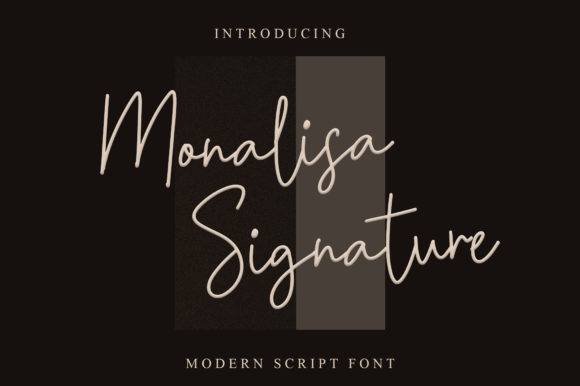
Monalisa Signature: A Refined Script Handwritten Font for Digital Elegance
As a web designer who builds high-conversion landing pages, boutique e-commerce sites, and brand-forward SaaS dashboards, I reach for Monalisa Signature when elegance must feel intentional—not ornamental. This Script Handwritten font isn’t just decorative; it’s a precision-crafted Fonts asset built for digital clarity and emotional resonance. Its delicate, thin lettered forms carry quiet confidence—no excess weight, no visual noise—just refined script rhythm that guides the eye without slowing it down.
Monalisa Signature for Hero Section Headlines and Brand-First Web Experiences
Monalisa Signature thrives in hero sections where first impressions define credibility and tone. Unlike heavier script fonts that blur at scale on mobile or bleed into background imagery, its fine strokes retain crispness even at 48px on retina displays. I use it exclusively for primary headlines—never body text—paired with a neutral sans serif (like Inter or Manrope) for contrast and scannability. On a luxury coaching site, “Your Journey Begins Here” set in Monalisa Signature over a soft gradient creates instant tonal alignment: calm, curated, human. That subtle ligature between “o” and “u” in “Journey” isn’t just aesthetic—it signals craftsmanship before the user reads a word.
Monalisa Signature for Online Store Banners and Product Launch Graphics
When designing banners for an online store—especially for artisan goods, bridal accessories, or premium skincare—I rely on Monalisa Signature to elevate product messaging without sacrificing readability. Its stylish alternates let me rotate between graceful swashes and simplified glyphs depending on context: a bold “Limited Edition” badge uses the most expressive alternate, while “Hand-Poured” on a product card opts for cleaner, tighter spacing. As a Script Handwritten font, it avoids the artificial stiffness of scripted system fonts—and as a commercial Fonts license, it supports WOFF2 embedding, variable font loading, and full CSS @font-face control across Shopify, Webflow, and custom React sites.
Monalisa Signature for Landing Page CTAs and Conversion-Focused Microcopy
CTAs need personality *and* purpose—and Monalisa Signature delivers both when used sparingly. I apply it only to short, high-intent phrases: “Reserve Your Spot,” “Begin the Ritual,” “Unlock Access.” Never on buttons with icons or dense labels—its thin lettering demands breathing room. On light backgrounds, I add a subtle 0.5px text shadow for legibility; on dark overlays, I pair it with a 10% opacity white fill and ensure minimum contrast meets WCAG AA. Because Monalisa Signature is a display-focused Script Handwritten typeface, it works best at 24–36px on desktop and scales cleanly to 20px on mobile with proper line-height and letter-spacing adjustments.
Monalisa Signature for Creative Portfolio Sites and Designer Brand Kits
Creative professionals—illustrators, lettering artists, UX designers—need portfolios that reflect their voice *before* the case study loads. That’s where Monalisa Signature becomes strategic typography. Used for names in logo lockups (“Maya Chen Design”), project titles (“The Willow Collection”), or subtle divider lines (“— Selected Work —”), it communicates refinement without pretension. Its ligatures (like the elegant “fi” and “fl” connections) add motion to static layouts, while stylistic alternates allow customization per section—soft curves for editorial work, tighter terminals for branding projects. As a licensed Fonts file, it includes OTF and WOFF2 formats, full Latin multilingual support, and OpenType features accessible via CSS font-feature-settings.
Monalisa Signature for Blog Headers and Editorial Digital Content
For blogs rooted in lifestyle, slow living, or conscious entrepreneurship, Monalisa Signature adds warmth to headers without undermining authority. I use it only for H1s and select pull quotes—not navigation or meta text. Its thin lettering demands careful pairing: a warm serif like Cormorant Garamond for body copy balances its delicacy, while a geometric sans like Poppins grounds subheads. On long-form pages, I limit Monalisa Signature to three instances per scroll depth to preserve impact. Because it’s a Script Handwritten font designed for digital legibility—not print flourish—it renders consistently across Chrome, Safari, and Firefox, with no fallback jank.
Monalisa Signature for Email Subject Lines and Social Media Story Text
In email marketing and Instagram Stories, where attention lasts under two seconds, Monalisa Signature stands out with intention—not clutter. I export short phrases as transparent PNGs (not embedded webfonts) for stories, using its most legible alternates at 40–52px size. For email subject lines in Mailchimp or Klaviyo, I avoid rendering it as live text (due to client-side font blocking), but I *do* use its rhythm to inform the tone of plain-text alternatives—e.g., “You’re invited ✦” mirrors its gentle cadence. As a premium Fonts asset, its commercial license covers use in branded email templates, social assets, and downloadable PDFs—no hidden restrictions for digital creators.
Monalisa Signature for Dark Mode Interfaces and Minimalist UI Layouts
Contrary to assumptions, thin script fonts can shine in dark mode—if engineered right. Monalisa Signature’s even stroke weight and open counters prevent visual collapse against #121212 backgrounds. I increase tracking by 40–60 units and use a 90% white fill (not pure #FFFFFF) to reduce glare. In minimalist dashboard UIs—think course platforms or wellness apps—I reserve it for welcome modals (“Welcome back, Alex”) or milestone badges (“Chapter Complete”). Its Script Handwritten authenticity feels human in otherwise algorithmic interfaces, building trust through tactile nuance. And because it’s a well-hinted Fonts package, it loads fast, supports variable weight fallbacks, and respects system font preferences when needed.
Practical Licensing Note for Web Designers and Agencies
All commercial licenses for Monalisa Signature include unlimited website use, client project deployment, SaaS integrations, and digital template resale—no per-page fees or domain limits. You’re covered for WordPress themes, Figma design systems, Notion brand kits, and hosted landing page builders. Just verify your license includes webfont files (it does) and check that your hosting environment supports CORS-enabled font loading—most modern platforms do out of the box.