Christmas Monoline: A Delicate Script Font for Elegant Branding
It started with a blank brand board—and a quiet, snow-dusted café in Portland that needed its first full visual identity. The owner, a ceramicist who also serves house-made lavender shortbread and small-batch herbal teas, wanted something warm but refined—never twee, never overdone. When I opened my font library and typed “Christmas Monoline” into the search bar, I wasn’t expecting much beyond seasonal charm. What I found instead was a Script Handwritten typeface with surprising versatility: delicate, yes—but also grounded, intentional, and quietly confident.
Christmas Monoline for Boutique Café Branding and Packaging Design
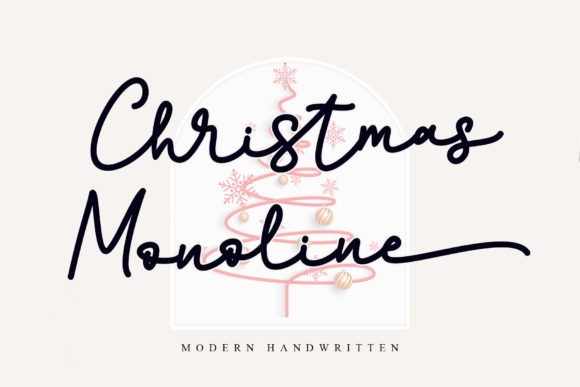
I dropped Christmas Monoline into the logo mockup first—just the shop’s name, set at 48pt on a cream kraft label. Instantly, it felt like the right kind of softness: not fragile, but considered. The letterforms have gentle contrast, subtle tapering strokes, and just enough personality to avoid looking generic. As a Fonts choice for a small-batch business, Christmas Monoline works best as a display font—ideal for signage, product labels, and menu headers. It’s not built for long paragraphs, but for moments where tone matters most: the handwritten tag on a tea tin, the foil-stamped name on a takeaway cup sleeve, or the centered title on a seasonal flyer.
What surprised me was how well it held up at smaller sizes. On a 1.5-inch sticker (think: honey jar or candle label), Christmas Monoline remained legible—especially when paired with a clean, low-contrast sans serif for supporting text. That pairing became our anchor: Christmas Monoline for voice, a light-weight geometric sans for clarity. No competing scripts. No heavy serifs muddying the warmth. Just two Fonts doing distinct, complementary jobs.
Christmas Monoline for Social Media Graphics and Website Headers
We tested Christmas Monoline across digital touchpoints next—Instagram story templates, website hero banners, and email newsletter headers. In web design, it performed beautifully as an SVG-loaded headline font (not embedded via @font-face, since variable support isn’t listed—but the OTF files work flawlessly in Figma, Adobe apps, and Canva). Its natural rhythm guides the eye without shouting: perfect for a boutique’s “New Seasonal Blend” announcement or a limited-edition holiday gift set.
One real-world observation: Christmas Monoline shines brightest against muted, natural backgrounds—linen textures, oatmeal paper scans, soft sage gradients. It fades slightly against busy patterns or high-contrast dark mode UIs unless carefully kerned and tracked. So we adjusted spacing manually in each layout—not a dealbreaker, just part of working with any premium Script Handwritten typeface.
Christmas Monoline for Holiday Product Labels and Handmade Goods
This is where Christmas Monoline truly earned its keep. For the café’s handmade lavender sachets and ceramic mug sets, we used it on hang tags, belly bands, and thank-you cards. Its elegance reads as artisanal—not mass-produced. Because Christmas Monoline is a lovely and delicate script font that exudes elegance and class, it subtly signals care in craft. Customers noticed. Not because they read the font name, but because the typography felt *intentional*: like the packaging had been touched by hand, twice.
We avoided using it for ingredient lists or legal disclaimers (obviously)—but for short-form text? Absolutely. “Hand-poured • Small batch • Made in Oregon” looked cohesive and calm in Christmas Monoline, especially with alternate glyphs enabled. The font includes thoughtful ligatures and swash capitals—subtle, not showy—that add polish without sacrificing readability.
Christmas Monoline for Wedding Invitations and Elegant Branding
Yes—it’s called *Christmas* Monoline, but don’t let the name box you in. I’ve since used it for a spring wedding suite (with olive-green ink on ivory cotton paper) and a botanical skincare launch (paired with a warm, humanist serif). Why? Because Christmas Monoline is a lovely and delicate script font that exudes elegance and class—not holiday kitsch. Its charm lies in restraint: no exaggerated flourishes, no forced bounce, no cutesy loops. It’s refined handwriting, not calligraphy-as-decor.
For wedding invitations, it’s ideal as a primary script—especially when printed letterpress or foil-stamped. It pairs effortlessly with classic serifs (think Garamond or Cormorant Garamond) or even minimalist sans fonts like Inter or Manrope for RSVP cards and details pages. As a Script Handwritten option, it bridges tradition and modernity—exactly what many couples and conscious brands seek today.
Christmas Monoline for Editorial Design and Creative Studio Identity
A local creative studio asked me to refresh their stationery suite last month—and Christmas Monoline became the quiet hero. Their old branding leaned heavily into bold sans serifs; the new direction needed warmth, texture, and a hint of narrative. We used Christmas Monoline only for the studio name on business cards and letterhead—then switched to a crisp, neutral sans for everything else. The result? Instant differentiation. It said “we make things with heart” without saying a word.
In editorial design—like a quarterly zine for makers—Christmas Monoline worked beautifully as a chapter opener or pull-quote font. Its delicate weight creates visual breathing room, letting photography and illustration take center stage while still anchoring the tone. It’s not a workhorse font, but a precision tool: best reserved for moments where emotional resonance matters more than utility.
How to Test Christmas Monoline Before Committing to a Full Brand System
Before licensing Christmas Monoline for client work, I always run three quick tests: (1) Type the business name in all caps and lowercase—does it retain character? (2) Set it at 12pt, 24pt, and 72pt on both screen and print mockups—where does it lose clarity? (3) Pair it with two other fonts (one serif, one sans) and ask: does it feel like part of a conversation—or a solo act?
Christmas Monoline passed all three. It includes standard OpenType features—ligatures, stylistic alternates, and multilingual Latin support—so it scales gracefully across markets. And as a commercial Fonts license, it covers digital, print, and merchandise use—no hidden restrictions. For designers building real brands—not just mood boards—this kind of reliability is non-negotiable.
If you’re choosing Christmas Monoline for your next project, remember: it’s not about filling space. It’s about inviting attention, conveying care, and adding a whisper of elegance that lingers. Whether you’re designing for a ceramicist, a florist, a skincare line, or a quiet corner café—this Script Handwritten font doesn’t shout. It simply says, softly and surely: this matters.